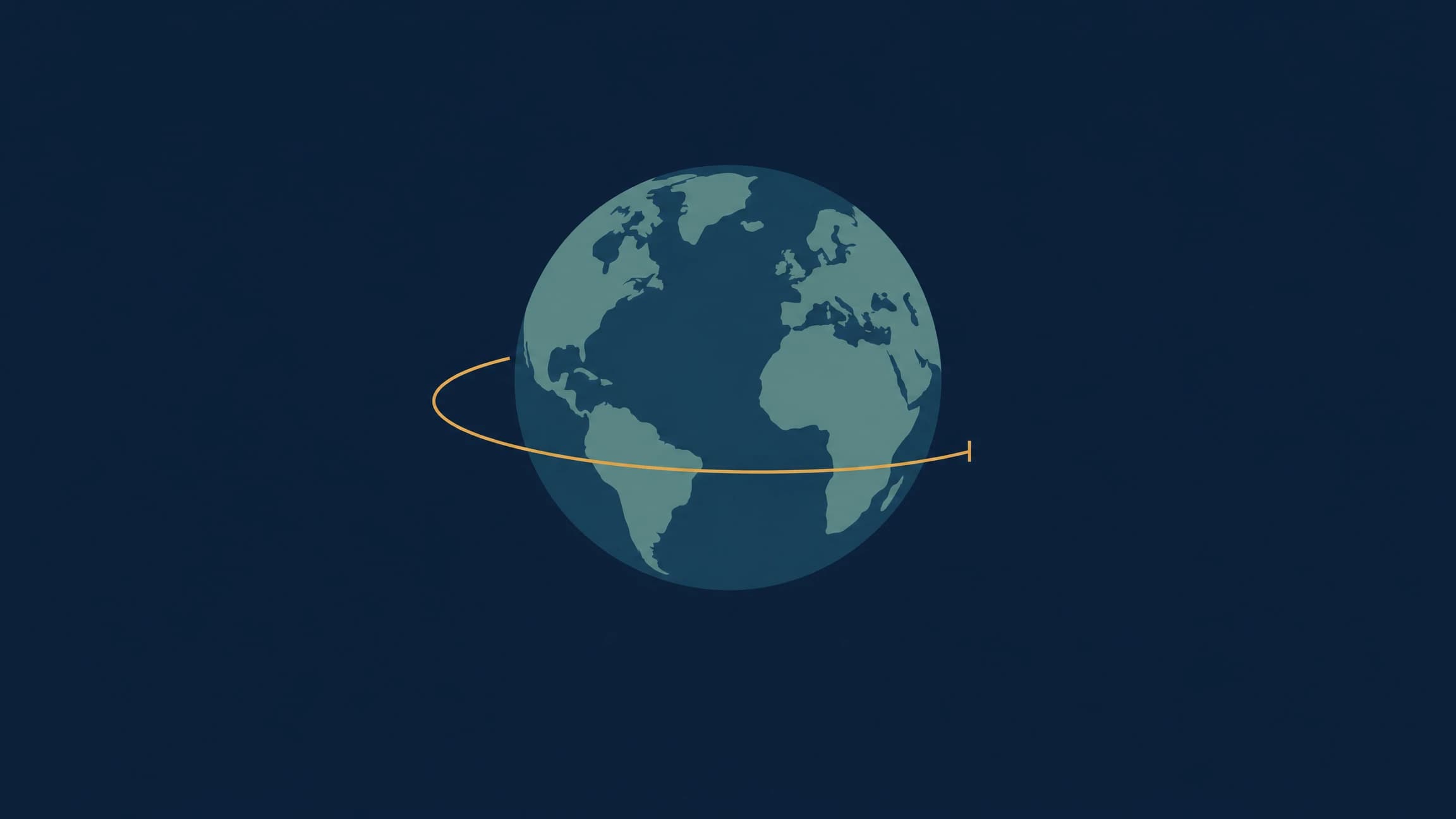
Earth doesn't spin at a stately, imperceptible pace. At the equator, the planet's surface is moving eastward at about 1,670 km/h (1,040 mph) — faster than a Boeing 747 at cruise. Everything on the surface, including the atmosphere and the oceans, shares that momentum. That single fact is the key to understanding why stopping the spin, in any timeframe, is a genuinely dangerous idea.
Two very different scenarios
Physicists who entertain this question usually split it into two versions, because the outcome depends almost entirely on the deceleration timeline. An instantaneous stop is not something any known force could realistically cause — Earth's rotational angular momentum is enormous — but it's a useful thought experiment. A gradual stop, over millions of years, is closer to something that could plausibly happen through tidal braking, the same mechanism that has already slowed Earth's rotation over its history.
Tidal friction from the Moon is already slowing Earth's rotation by about 1.7 milliseconds per century. This is measured directly through changes in day length recorded by atomic clocks and confirmed independently by ancient eclipse records. It's the real-world mechanism scientists point to when modeling a 'gradual stop' scenario.
If it happened instantly
In the instant version, the ground would stop, but the atmosphere and oceans would not — momentum doesn't disappear just because the surface beneath it does. The result would be winds approaching that 1,670 km/h equatorial rotation speed, several times stronger than the strongest hurricanes on record, tearing across the surface as air and water 'kept going' relative to the now-stationary ground. Coastal regions would face tsunamis generated not by an earthquake but by the ocean's own momentum sloshing against newly stationary coastlines.
If it happened gradually
The slow version is less violent but arguably stranger to live through. As rotation slowed, the length of the solar day would stretch. If Earth eventually stopped rotating relative to the distant stars while continuing to orbit the Sun, the planet would no longer have a normal 24-hour cycle: most locations would experience roughly months of daylight followed by roughly months of darkness.
What would happen in the first 24 hours?
For an instantaneous stop, the first minutes would be catastrophic. The solid ground would decelerate, but the atmosphere and oceans would retain most of their eastward momentum. Near the equator, that relative motion starts at about 1,670 km/h. Air and water would rush across the surface, producing extreme winds, enormous waves, and widespread destruction. The exact pattern would depend on latitude, topography, ocean basins, and how the hypothetical force stopped the planet.
- At the equator, the ground would lose roughly 465 m/s of rotational speed relative to the inertial frame.
- The atmosphere would initially keep moving eastward relative to the newly stopped surface.
- Ocean water would continue moving too, creating continent-scale flooding and destructive waves.
- Objects not firmly attached to the ground would also continue moving until friction and collisions slowed them down.
A timeline of the hypothetical stop
In an instantaneous stop, the ground loses its rotational motion while the atmosphere, oceans, and unattached objects initially retain it. The relative motion would be devastating.
Winds, waves, fires, debris, and structural failures would continue to reshape the surface. The exact pattern would depend strongly on latitude and geography.
The immediate momentum-driven disaster would dominate the instant-stop scenario. In a gradual scenario, the changes would instead be subtle at first and accumulate over a very long period.
If rotation were being slowed slowly, day and night would become progressively longer, forcing ecosystems, agriculture, weather patterns, and human infrastructure to adapt.
A non-rotating Earth would have a radically different climate and surface environment. The final state would depend on how the slowdown happened and how the atmosphere and oceans redistributed heat.
Would humans survive?
An instantaneous stop would be effectively unsurvivable for most people near the surface. The danger would not come from losing a mysterious 'centrifugal force' and suddenly being pulled into space; it would come from the enormous relative motion between the ground and everything that had been rotating with Earth. A gradual slowdown is different: humans could potentially adapt if it happened over an extremely long timescale, but agriculture, climate, ecosystems, infrastructure, and civilization would all face profound changes.